I found some of these comments about Eddie Murray's 1978 cards worth thinking about.
https://forums.collectors.com/discussion/1040886/1978-eddie-murray
What do you think about this?
Showing posts with label 1978. Show all posts
Showing posts with label 1978. Show all posts
Tuesday, July 21, 2020

Saturday, December 28, 2019
Issues with 1978 and 1979 Kellogg's Cards
I'm working on sorting the 1978s and 1979s. I have two different issues with these two sets. The 1979s have two different styles, normally called Red and Orange referring to the Kellogg's name on the front. The 1978s have one big problem.
The red set consists of thin card stock with a bright white background color and border. The orange set in on a thick card stock, or at least the plastic coating is thick. These orange cards have a dull finish that looks like it was a mistake somehow. There seems to be a lot of color variation with the orange cards and some look quite bad.
It was easy to sort the 1979s since I think I only acquired three of them in the last few years. I had lots of these cards early on and I kept buying cheap lots to work on obtaining all of the variations. That project has stalled since I am just about done. Now I am hoping to get the unopened pack variations.
I also didn't get many 1978s in the last few years since I'd bought a few large lots years ago. I have so many of these cards with cracks. For some Kellogg's sets a few cracks don't look bad. The 1978s have cracks and bubbles that really do look bad sometimes.
On to the 1977s, where I don't have lots of cards. I hope that is easy.
The red set consists of thin card stock with a bright white background color and border. The orange set in on a thick card stock, or at least the plastic coating is thick. These orange cards have a dull finish that looks like it was a mistake somehow. There seems to be a lot of color variation with the orange cards and some look quite bad.
It was easy to sort the 1979s since I think I only acquired three of them in the last few years. I had lots of these cards early on and I kept buying cheap lots to work on obtaining all of the variations. That project has stalled since I am just about done. Now I am hoping to get the unopened pack variations.
I also didn't get many 1978s in the last few years since I'd bought a few large lots years ago. I have so many of these cards with cracks. For some Kellogg's sets a few cracks don't look bad. The 1978s have cracks and bubbles that really do look bad sometimes.
On to the 1977s, where I don't have lots of cards. I hope that is easy.
Friday, November 23, 2018
1978 Kellogg's Baseball Card Backs - #13 - 15
Back for another look at some 1978 Kellogg's baseball card backs. The writers in 1978 did a much better job of making things interesting. This is much better than Black Friday shopping.
#15 - Jeff Burroughs

Burroughs was involved in a big trade from Texas to Atlanta where he hit 41 homers. He was unhappy with the Rangers because as Kellogg's stated the Burroughs was "unhappy with the southerly breezes at the Rangers' Arlington Stadium."
Not on the card - he was traded for five players and cash. Have other players been traded because they complained about the direction of the wind?
Not on the card - he was AL MVP in 1974.
Not on the card - Burroughs played for the Washington Senators in 1970 and 1971. His last game was in 1985. Do you know who was the last active major leaguer to have played for the Senators team that moved to Texas for the 1972 season? How about the last active player who played for the Senators team that moved to Minnesota for the 1961 season. Hint - both had Kellogg's cards.
Players who were the last active players for the Milwaukee Braves, New York Giants and Kansas City A's also got onto a Kellogg's card. Any ideas?


#15 - Jeff Burroughs

Burroughs was involved in a big trade from Texas to Atlanta where he hit 41 homers. He was unhappy with the Rangers because as Kellogg's stated the Burroughs was "unhappy with the southerly breezes at the Rangers' Arlington Stadium."
Not on the card - he was traded for five players and cash. Have other players been traded because they complained about the direction of the wind?
Not on the card - he was AL MVP in 1974.
Not on the card - Burroughs played for the Washington Senators in 1970 and 1971. His last game was in 1985. Do you know who was the last active major leaguer to have played for the Senators team that moved to Texas for the 1972 season? How about the last active player who played for the Senators team that moved to Minnesota for the 1961 season. Hint - both had Kellogg's cards.
Players who were the last active players for the Milwaukee Braves, New York Giants and Kansas City A's also got onto a Kellogg's card. Any ideas?

#14 - Paul Dade

He was one of the earlier free agents in 1976. He hit .291 in his first MLB season. He was also a football star in high school.
Not on the card - Dade only played until 1980. He played in Japan in 1981 and then in the minors in 1982.
Not on the card - like lots of players, Dade had a Topps card in 1981 even though his last MLB game was in 1980.

#13 - Chris Chambliss

I like his hobby - record collecting. I bet he had some good stuff.
Because of his homer to win the 1976 AL pennant I remember him as a slugger. He was AL Rookie of the Year in 1971.
He was traded to the Yankees in 1974.
One of my favorite write-ups as it mentions that Chambliss has been a regular in the Yankee lineup, he just come to play ball and he has "carefully refrained from becoming involved in the controversial club house antics that have brought the Yankees so much publicity". I think they intentionally left out the word negative before publicity.

Thursday, November 22, 2018
1978 Kellogg's Baseball Card Backs - #16 - 18
Back for a look at three more cards backs from the 1978 Kellogg's baseball card set.
#18 - John Candelaria


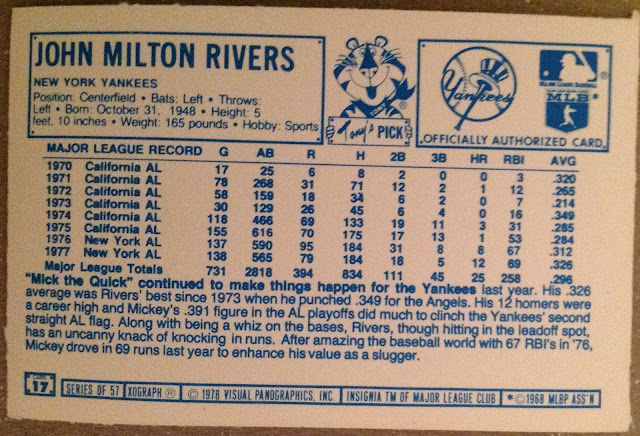
#17 - Mickey Rivers

Two cards in a row where the player's nickname is mentioned in the text. He hit .326 in 1977.
His base running is mentioned, but not how many steals he had. He led the league with 70 in 1975 and he swiped 267 in his career.
Not on the card - he was traded by the Angels to the Yankees for Bobby Bonds.


#18 - John Candelaria

20-5 in 1977 - wow! 2.34 ERA - wow! The first Pirate since Bob Friend in 1955 to win the NL ERA title. I've got a lot of Bob Friend cards from the 1950s, but I never guessed he'd be mentioned on a Kellogg's card. I bet Bob didn't either.
Lew Alcindor is also mentioned since Candelaria finished second in career scoring in the Catholic school basketball league.
He won his first career game against Tom Seaver.
This could be a record for the most players mentioned on the back of the card.
He became the first Pirate to throw a no-hitter in Pittsburgh. How could that be?
Not on the card - according to multiple sources, the first Pirate no-hitter was in Pittsburgh by Nick Maddox in 1907.
Not on the card - Bob Friend had a son who played on the PGA Tour.
Not on the card - I didn't know that he ended up playing for eight different teams.

#17 - Mickey Rivers

Two cards in a row where the player's nickname is mentioned in the text. He hit .326 in 1977.
His base running is mentioned, but not how many steals he had. He led the league with 70 in 1975 and he swiped 267 in his career.
Not on the card - he was traded by the Angels to the Yankees for Bobby Bonds.

#16 - Jose Cruz

Jose likes swimming. He had career highs in almost every category in 1977. He is the eldest of three MLB brothers. St. Louis continues to regret his sale to Houston.
Tommy Cruz played three games for St. Louis in 1973 and four games for the White Sox in 1977.
Hector Cruz also debuted in the big leagues in 1973 with St. Louis. He played 11 games that season and stayed with the team until 1977. He lasted in the majors until 1982.
Jose was with the Cardinals from 1970 - 1974. What about 1973? Did the brothers play together?
In his debut Tommy pinch-ran in the 8th inning but he was replaced by Jose in the field. Jose drove in the winning run in the 9th inning.
Hector didn't play in any of the games where Tommy played. They couldn't match the Alou brothers who did for an entire outfield in a game. Plus, two Alous got a Kellogg's card and only Jose Cruz got one for his family.
Both families had the next generation make it to the majors - Jose Cruz, Jr. and Moises Alou. Mel Rojas is a cousin of Moises Alou.

Tuesday, November 13, 2018
1978 Kellogg's Baseball Card Backs - #25 -27
Back to the 1978 countdown. This one is taking a while. I hope to get distracted again from this process when I go to the big card show in Rosemont this weekend and have something to report.
At some point it must be difficult to find things to say for Kellogg's. This must be true with Seaver and Carew, who are both regulars in the Kellogg's sets.
#27 - Tom Seaver


#26 - Larry Bowa


#25 - Eddie Murray


At some point it must be difficult to find things to say for Kellogg's. This must be true with Seaver and Carew, who are both regulars in the Kellogg's sets.
#27 - Tom Seaver

Seaver has a birthday in a couple of days.
They certainly had something to write about this year on Seaver's card. He was traded mid-season in what Kellogg's called a controversial trade. He ended up 21-6 anyway.
He is now the #10 pitcher on the all-time strikeout list.
Not on the card - the Mets didn't get any stars for Seaver, they also traded Dave Kingman that day and their team was poor for a few years following these deals.
Oddity on the card - check out the 1968 stats under BB. The number isn't aligned with the other numbers in that column.

#26 - Larry Bowa

It's always great to see the older Phillies logo.
Bowa has a string of defensive records. He has a "magic glove". He created a record by making only nine errors in over 150 games at shortstop.
Not on the card - he won how many Gold Gloves? Only two. Bowa played from 1970 - 1985. Ozzie Smith won all of them from 1980 - 1982. Here are the winners from the 1970s.
1970 - Don Kessinger
1971 - Bud Harrelson
1972 - Larry Bowa
1973 - Roger Metzger
1974 - Dave Concepcion
1975 - Dave Concepcion
1976 - Dave Concepcion
1977 - Dave Concepcion
1978 - Larry Bowa
1979 - Dave Concepcion
Shortstop has always been a key position in baseball and Kellogg's recognized that. All the Gold Glove winners got into a Kellogg's set except Roger Metzger.

#25 - Eddie Murray

Murray had a great rookie season and he missed only one game on his way to Rookie of the Year honors.
I like that the card mentions his high school by name - Locke High.
Murray was mostly used as a DH.
Not on the card - in his career he played DH 573 times, 1B 2,413 times along with six games at 3B and three games in the outfield.

Tuesday, October 23, 2018
Kellogg's Baseball Card Backs - #28 - 30
60-degree weather was a great thing to have when the heat is out in October. How many teams had domed stadiums in 1978 to make life easier in poor weather? Houston and Seattle had one. Did I miss any others?
Back to the cards.
#30 - Thurman Munson


Back to the cards.
#30 - Thurman Munson

I didn't realize that he hit .300 and had 100 RBIs during three years in a row.
Kellogg's called him a stocky catcher at 5-11 and 190 pounds.
I didn't remember that Munson had an "undiplomatic approach to some team matters".
Not on the card - shockingly, Reggie Jackson's ego was involved. I imagine that Billy Martin and George Steinbrenner were also involved.
Not on the card - his career average was .292. He was only 32 when he died in a plane crash during the 1979 season.

#29 - Rod Carew

Another batting title in addition to career highs in runs, hits, doubles triples and RBIs. Career is bound for the Hall of Fame, but he's still looking for a trip to the World Series.
Not on the card - a .335 career average at this point in his career is a good start toward the Hall of Fame.
Not on the cards - Kellogg's didn't mention that he had his fifth consecutive top-10 finish in the MVP voting and that he won his only MVP Award in 1977. He also continued his streak of being an all-star every year, a streak which continued until his last MLB season.

#28 - Garry Maddox

In the history of baseball only six players have spelled their first name "Garry". Two of them are in this card set.
I don't know why Kellogg's mentioned that injuries held him back in 1977 since he only missed 23 games.
Maddox spent two years in Viet Nam so he missed all of 1969 and 1970. That I didn't know. Wikipedia mentioned that an exposure to chemicals in Viet Name led him to sensitive skin which led him to always have a beard as a player.
Kellogg's said that the Phillies made a wise deal with the Giants in obtaining Maddox in 1975.
Not on the card - sometimes Kellogg's mentioned the players in the trade, but not this time. He was traded for Willie Montanez.

Sunday, October 14, 2018
1978 Kellogg's Baseball Card Backs #37 - 39
So, I survived the marathon only to get caught up in two other big things this week - hosting our conference cross country meet and having two days of parent-teacher conferences. Luckily, I teach at a competitive school so the conferences weren't bad at all.
As for the meet, that took up lots of my waking hours this week since the actual course is 35 miles from my school. For the first time in four years our team won, so that made the lack of sleep this week a bit easier to tolerate.
Back to the countdown.
#39 - Bob Bailor


#38 - Alan Bannister

#37 - Ralph Garr


As for the meet, that took up lots of my waking hours this week since the actual course is 35 miles from my school. For the first time in four years our team won, so that made the lack of sleep this week a bit easier to tolerate.
Back to the countdown.
#39 - Bob Bailor

He was a rookie, he hit .310 and he was a Blue Jay. I guess that made him a good choice since no Blue Jay exceeded 19 homers or 64 RBIs. No pitcher exceeded 13 wins or eight saves. It shouldn't surprise anyone that the team won only 54 games.
Lots of professional athletes were stars in other high school sports. Bob was an all-state basketball player - you don't see a lot of 5-10 guys doing that today.

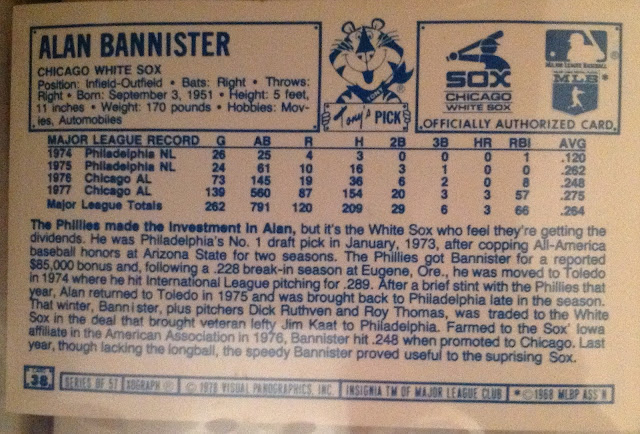
#38 - Alan Bannister

Bannister had the same career as Bailor. Maybe they are twins separated at birth. Both were #1 draft picks too.
years G AB H AVG HR SB
Bailor 75-85 954 2937 775 .264 09 90
Bannister 74-85 972 3007 811 .270 19 108
I think Bannister had a great start in 1977, which got him a card in 1978. It also helped that the stars of the 1977 Southside Hit Men, Oscar Gamble and Richie Zisk, were gone from the White Sox after 1977.
He got to the White Sox in a trade that sent Jim Kaat to the Phillies.
Kellogg's mentioned that Bannister didn't have any power. 19 homers in 3007 at-bats in his career proved Kellogg's to be correct.
Jim Kaat came up in a trivia question that I got partially correct recently. I had to come up with a batter from the 1930s who faced a pitcher while that same pitcher faced a second hitter who played past the year 2000. I didn't get Kaat without looking at a baseball database, but without using the computer I came up with a combination of three players that went from 1940 to 2007. I had the other two players that combined with Kaat in this odd trio. Any ideas?

#37 - Ralph Garr

This set certainly has some interesting choices for Chicago players. The Road Runner was fun to watch. At this point in his career his career average was .313.
Not on the card - he finished his career with an average of .306. He hit .307 during the 1970s. Can you name the other five players who hit over .300 during the 1970s with at least 4,000 at-bats? I made up that number to rule guys out who started in 1975.
He won an NL batting title. He attending "football famous" Grambling.

Monday, October 8, 2018
1978 Kellogg's Baseball Card Backs #40 - 42
Today is a day where I expect to sit a lot. Maybe I will do today's post and one for tomorrow. The rain in the marathon really got to me yesterday. I like the rain, but once my shoes got wet and no longer had any useful cushioning, my back, feet and ankles got sure.
I kept going because I know my team would give me a hassle if I didn't and I knew that even with the last four miles being really slow I'd still hit the Boston Marathon qualifying time. Too bad I have no interest in running another paved marathon. I still to trails for anything longer than 13.1 miles, if I am even ever going to race that far again.
Back to the cards.
#42 - Burt Hooton.

At least Kellogg's got his name correct. Hostess had a tough time with that.
Wow, only 102 innings in the minors. And 35-3 with a 1.14 ERA in college.
I didn't know that Tommy Lasorda saw him pitch in winter ball and then got the Dodgers to trade for him.
Not on the card - The Cubs got Eddie Solomon and Geoff Zahn. Solomon lasted just over two months and six innings while Zahn played the remainder of the 1975 season and all of 1976 with the Cubs before they released him. Zahn played nine more years, eight as a regular in the starting rotation. He even got a 1979 Kellogg's card.
Not on the card - a good choice for inclusion in the set this year. He finished second to Gaylord Perry in the Cy Young voting in 1978.

#41 - Cecil Cooper

I had forgotten that Cooper played with the Red Sox at the start of his career. I need to look at my 1970's Topps card more often. He finished his career with 11 seasons in Milwaukee - AL.
That was quite a big trade with Boston - Cooper for Bernie Carbo and George Scott in December of 1976. That didn't make sense since I knew Carbo was in the 1975 World Series with the Red Sox. Carbo was traded to Milwaukee in June of 1976 - something I certainly didn't remember. I do remember Scott being on the Brewers and Red Sox. Scott also had previous been traded to the Brewers from the Red Sox.
Cooper hit .311 for the 1975 Red Sox. I would not have been able to place him on that team. That shows how much less I knew about the American League.
He had his best season in 1977. More was to come - he got MVP votes every year from 1979 - 1983 and he led the league in RBIs twice.

#40 - Reggie Jackson


I kept going because I know my team would give me a hassle if I didn't and I knew that even with the last four miles being really slow I'd still hit the Boston Marathon qualifying time. Too bad I have no interest in running another paved marathon. I still to trails for anything longer than 13.1 miles, if I am even ever going to race that far again.
Back to the cards.
#42 - Burt Hooton.

At least Kellogg's got his name correct. Hostess had a tough time with that.
Wow, only 102 innings in the minors. And 35-3 with a 1.14 ERA in college.
I didn't know that Tommy Lasorda saw him pitch in winter ball and then got the Dodgers to trade for him.
Not on the card - The Cubs got Eddie Solomon and Geoff Zahn. Solomon lasted just over two months and six innings while Zahn played the remainder of the 1975 season and all of 1976 with the Cubs before they released him. Zahn played nine more years, eight as a regular in the starting rotation. He even got a 1979 Kellogg's card.
Not on the card - a good choice for inclusion in the set this year. He finished second to Gaylord Perry in the Cy Young voting in 1978.

#41 - Cecil Cooper

I had forgotten that Cooper played with the Red Sox at the start of his career. I need to look at my 1970's Topps card more often. He finished his career with 11 seasons in Milwaukee - AL.
That was quite a big trade with Boston - Cooper for Bernie Carbo and George Scott in December of 1976. That didn't make sense since I knew Carbo was in the 1975 World Series with the Red Sox. Carbo was traded to Milwaukee in June of 1976 - something I certainly didn't remember. I do remember Scott being on the Brewers and Red Sox. Scott also had previous been traded to the Brewers from the Red Sox.
Cooper hit .311 for the 1975 Red Sox. I would not have been able to place him on that team. That shows how much less I knew about the American League.
He had his best season in 1977. More was to come - he got MVP votes every year from 1979 - 1983 and he led the league in RBIs twice.

#40 - Reggie Jackson

A great write-up. He had just hit three homers in a World Series game to tie Babe Ruth's record.
Not on the card - he hit five homers in the six game to win World Series MVP, which he also won in 1973 with the A's.
The Reggie Bar debuted in 1978. Reggie had said "if I played in New York they'd name a candy bar after me".
Other quote by Catfish Hunter about the Reggie bar -
"When you open it, it tells you how good it is".

Sunday, September 30, 2018
1978 Kellogg's Baseball Card Backs #46 - 48
I really like that this set has lots of text and very little blank space. Problem - so far the text has been really boring. I hope there is some better writing ahead.
#48 - Bruce Sutter


#48 - Bruce Sutter
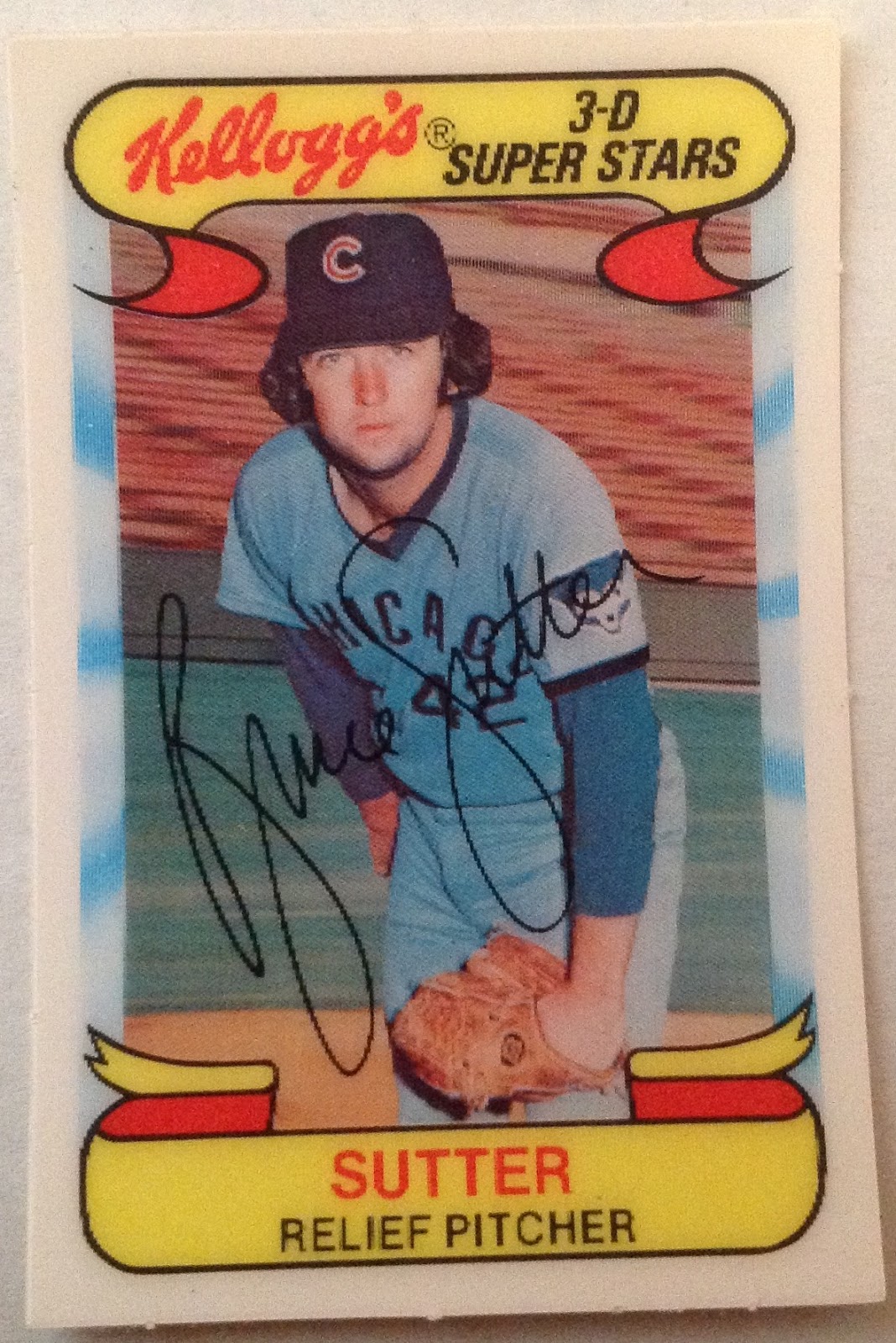
One of my favorite Kellogg's cards. When Sutter became a closer for the Cubs, things were good. One problem - the Cubs weren't good enough to make the playoffs anyway. The 2018 team could use someone like Sutter.
Oddly, the card doesn't even have the save stats on there.
I've always been a Cub fan, but I never heard anyone call them the "Little Bears" like Kellogg's did.
This card is more interesting. Sutter discovered the fork ball after arm surgery in 1972. Fred Martin, a Cub instructor, taught him the pitch. Here is what Wikipedia says about Sutter and the split-finger fastball - https://en.wikipedia.org/wiki/Split-finger_fastball.
He led the team with six saves in 1976. Really?
Not on the card - baseball-reference.com shows Sutter with 10 saves in 1976. I guess Kellogg's was wrong.

#47 - Mitchell Page

Kellogg's would take chances with some younger players. Page hit .307 as a rookie in 1977. He stole 42 bases and had 75 RBIs.
Kellogg's really dissed the A's calling them a "tail-end team" and calling Page "one of the few bright spots".
Not on the card - the A's won 91 games in 1976 and then only 65 games in 1977.
Not on the card - he was runner up to Eddie Murray in the AL Rookie of the Year voting.
Not on the card - he only played eight seasons. In only his first four seasons did he get into more than 57 games.

#46 - Lyman Bostock

Three seasons and a .318 average. Wow, this guy was quite the hitter. And he had Maury Wills helping him with base running.
His father played in the Negro Leagues. He signed with the Angels late in 1977 - the Angels logo is shown on the back of the card.
Not on the card - he hit .296 in 1978 to drop his career average to .311. In the last week of the 1978 season after a game against the White Sox in Chicago, he was shot and killed in one of his childhood hometowns - Gary, Indiana. I remember reading the story in the paper before doing my paper route that day.

Monday, September 24, 2018
1978 Kellogg's Baseball Card Backs #49 - 51
Back to check out three more card backs from the 1978 set.
#51 - Nolan Ryan


#50 - Bob Forsch


#51 - Nolan Ryan

A 1970s Kellogg's set price and interest depends a lot on whether Nolan Ryan is included. His record from the late 1960s through 1971 show why he didn't appear during the first few years.
Through 1977 he already held the record for the most years with 300+ strikeouts (four) and he's already tied for the most no-hitters (four).
Not on the card - he ended up with seven no-hitters and six seasons of 300+ strikeouts.
Not on the card - I'm not a Nolan Ryan fan, but he led the league in ERA one year with a record of 8-16. That record got him fifth in the Cy Young voting. Houston must not have been that good in 1987.

#50 - Bob Forsch

I like the Cardinals logo used during the early years of Kellogg's.
I didn't know that he became a pitcher because he couldn't hit well enough to stick in the minors as a position player.
Not on the card - he hit 12 more homers than his brother Ken did. Bob won two Silver Slugger Awards with those 12 homers and Ken had none.
#49 - Jim Rice

Rice won 10 letters in four sports during high school. He was injured in September of 1975 so he missed the playoffs and one of the greatest World Series.
Not on the card - he was third and fourth in the MVP voting in 1975 and 1977. He won the MVP in 1978 and had three more top-five finishes in his career

Sunday, September 23, 2018
1978 Kellogg's Baseball Card Backs #52 - 54
I'm back after staying away from the computer with a sore back. All should be good for running a marathon in two weeks. Here are the next three Kellogg's baseball cards from the 1978 set.
#54 - Frank Tanana


#53 - Bert Blyleven


#52 - Dave Parker


#54 - Frank Tanana

Tanana and Nolan Ryan were quite a duo in the middle of the 1970s. His arm was "overworked" at the end of the 1977 season so he missed a few starts. He struck out over 200 hitters for the third year in a row.
He wanted to be known as the best pitcher in baseball.
Not on the card - he played from 1973 to 1993, winning 240 games and losing 236. I guess that rest helped him to a long career. He won 18 games in 1978 but never surpassed 15 again.

#53 - Bert Blyleven

Blyleven already has four one-hitters and a no-hitter. He was second in ERA to Tanana in 1977.
He was traded after the 1977 season to the Pirates. Notice the Pirates logo on the back even though he's pictured on the front as a Ranger.
Not on the card - another pitcher with a long career, he pitched from 1970 to 1992. His career record was 287-250. He only received Cy Young votes in four seasons - not very Hall of Fame worthy in my opinion.

#52 - Dave Parker

Parker was a huge star in the late 1970s. He was the 1977 NL Batting Champ. He struggled with knee and hamstring problems in the past.
He was a three-sport star in high school. Kellogg's added that many observers expect him to be a star for years to come.
Not on the card - all three in this post had long careers. Parker played from 1973 to 1991. The 1978 NL MVP received MVP votes in nine seasons.

Subscribe to:
Posts (Atom)